
By 1812Blockhouse
At first glance, the numbers offer reassurance. Through April 12, the Ohio State Highway Patrol reports 464 crashes have been investigated in Richland County, down notably from 541 during the same period in 2025. That decline suggests safer roads, or at least fewer incidents requiring response.
But the broader picture is more complicated. Even as crashes decrease, several enforcement categories point to underlying risks that have not gone away—and in some cases, are growing.
Fatal Crashes: A Stark Reminder
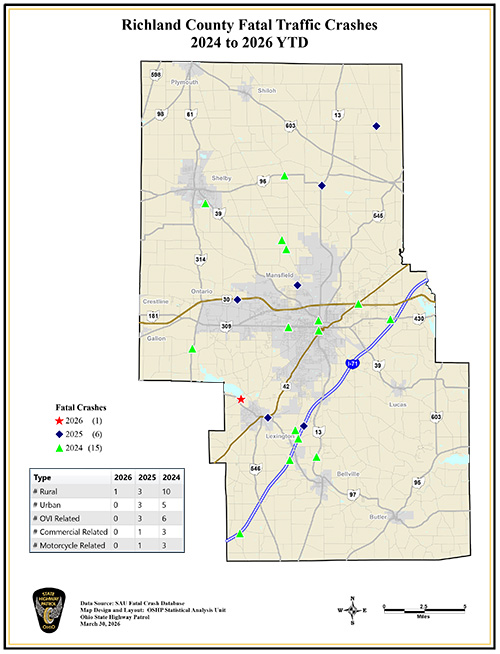
The map of fatal crashes across Richland County tells a sobering story. Fifteen lives were lost in 2024, six in 2025, and already one in early 2026. While the year-to-date number is lower, the geographic spread—from rural roads to key corridors near Mansfield—underscores a persistent reality: fatal incidents are not confined to one type of roadway or community. Rural roads, in particular, continue to account for a disproportionate share of fatalities over time.
Enforcement Trends Tell Their Own Story
If crashes are down, enforcement activity suggests why—and what still needs attention.
- OVI enforcement has jumped from 79 to 105 cases
- Seatbelt enforcement has risen sharply from 110 to 163
- Warnings issued increased significantly from 1,000 to 1,388
At the same time:
- Speed violations dipped slightly (1,118 to 1,088)
- Distracted driving citations edged down (229 to 218)
This combination points to a strategic shift. Troopers appear to be focusing more heavily on high-risk behaviors—impaired driving and seatbelt compliance—while maintaining steady pressure on speed and distraction.
More Visibility, More Assistance
Another number stands out: non-enforcement activity climbed from 4,003 to 4,426. That includes:
- Increased motorist assists (845 to 902)
- More on-road presence without direct citations
This is often the quiet side of highway safety—helping stranded drivers, managing traffic, and maintaining visibility that can deter risky behavior before it escalates.
The Rural Factor
The breakdown of fatal crashes over recent years reinforces a long-standing issue. Rural roads accounted for:
- 10 fatalities in 2024
- 3 in 2025
- 1 so far in 2026
These roads often combine higher speeds, fewer lighting resources, and longer emergency response times. Even with fewer total crashes, the margin for error remains thin.
What It Means Going Forward
Taken together, the data suggests a county in transition.
- Fewer crashes may reflect effective enforcement and driver awareness
- Higher OVI and seatbelt enforcement signals continued concern about preventable risks
- Stable speeding numbers indicate persistent habits that are harder to shift
The early 2026 numbers are encouraging, but not definitive. For Richland County, the trend line is moving in the right direction. The question now is whether it holds.