By 1812Blockhouse
A large-scale development proposed for northern Richland County is being framed as something entirely new: a data center campus that not only powers artificial intelligence operations, but also grows food. It’s novel approach is generating both interest and opposition.
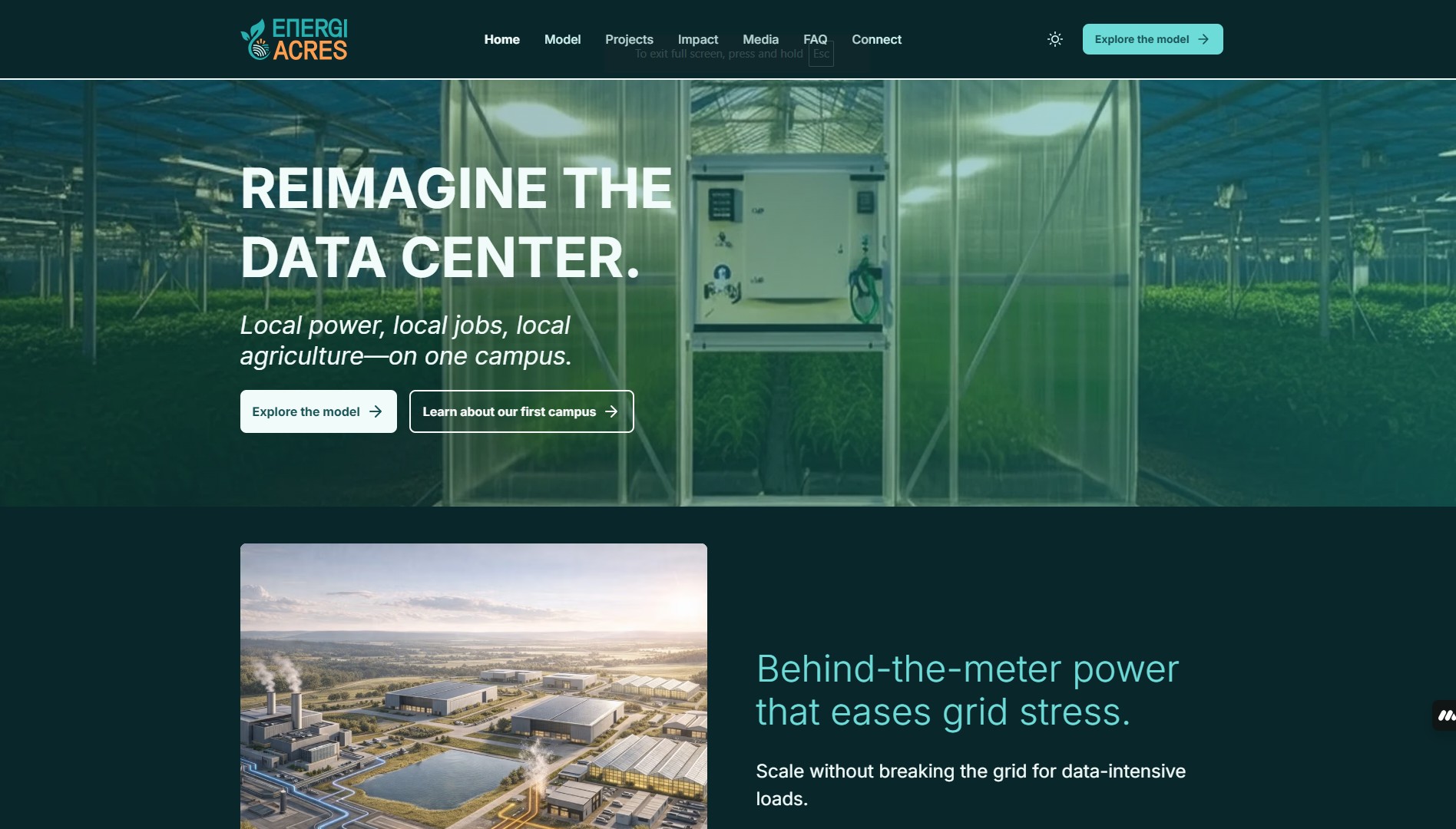
The project, led by infrastructure developer EnergiAcres, would span approximately 600 to 700 acres of Franklin Township farmland northeast of Mansfield Lahm Regional Airport. The concept brings together on-site power generation, high-performance computing, and controlled-environment agriculture into a single, integrated system.
Learn more about the company and its model at EnergiAcres’s website: https://www.energiacres.com/
From farmland to “AI factories”
The proposed site stretches from Ernsberger Road to Amoy Ganges Road and according to organizers “could” be annexed into the City of Mansfield to allow access to water, sewer, and road infrastructure. Groundbreaking is currently targeted for 2027, although the project remains in pre-development, with land control, entitlements, and utility planning underway. At its core, the campus would function as a series of what the developer calls “AI factories,” large-scale data processing facilities supported by dedicated energy infrastructure. That infrastructure would draw on natural gas delivered via the nearby Rover Pipeline, with plans for future renewable integration.
Designed to work as one system
Unlike traditional data center projects, EnergiAcres is proposing a campus where each component feeds into another.
Power generation, computing, agriculture, and water systems would be engineered together rather than built as separate pieces. The company’s approach centers on capturing and reusing outputs that are typically wasted. The envisioned power system includes a 100-megawatt grid connection paired with 400 megawatts of on-site, behind-the-meter generation. By producing electricity directly on site, the project aims to avoid delays tied to grid expansion while providing consistent, dispatchable energy.
Turning waste into production
A defining feature of the proposal is how it handles heat and emissions. Instead of venting excess heat from turbines and data center cooling systems, the campus would capture and redirect that energy into adjacent greenhouse operations.
Carbon dioxide produced during power generation would also be captured and reused, becoming an input for plant growth rather than a byproduct released into the atmosphere. This integration allows the campus to support greenhouse agriculture ranging from 5 to 40 acres. Using steady heat and food-grade CO₂, crops could be grown year-round, including through winter months, and distributed commercially to grocery stores, schools, and hospitals.
A closed-loop approach to water
Water systems are also designed to operate within a loop. Rainwater and condensation from cooling systems would be collected and stored on site. That water would first be used for equipment cooling, then redirected to irrigate crops in the greenhouses. The intent is to reduce reliance on municipal water supplies while increasing resilience during periods of drought or stress on local systems.
Economic promise — and local concern
EnergiAcres founder Shawn Cutter has said he is “90% certain” the project will move forward. He has pointed to the potential for high-paying and engineering jobs, along with secondary development such as hotels and restaurants. He also indicated that another company may invest $1 billion to construct a power plant tied to the campus.
The proposal has also drawn direct public attention. Cutter appeared at a recent Franklin Township Trustees meeting, where numerous residents were present to hear details and ask questions about the project. At the same time, a group of concerned Mansfield and Richland County residents has begun organizing in opposition. For many, the scale of the development and its location on hundreds of acres of farmland raise fundamental questions about its long-term impact.
Concerns voiced include potential noise from power generation, risks to water quality, effects on property values, and increased traffic on rural roads.
A project at the intersection of larger trends
The proposal reflects several forces reshaping communities across the country: the rapid expansion of AI-driven data centers, growing pressure on electrical infrastructure, and renewed interest in local food production through controlled environments. EnergiAcres is positioning its model as a way to address all three, combining energy production, computing, and agriculture into a single operational system.
Despite the detailed vision, significant questions remain. Final zoning and annexation decisions have yet to be made, and key details such as verified job numbers, long-term environmental impacts, and the project’s net water and emissions footprint are still unclear. It is also unknown whether similar integrated campuses have been successfully developed and operated at this scale.
The bottom line
If realized, the proposed campus north of Mansfield would represent a notable shift in how data centers are conceived and integrated into their surroundings. Rather than functioning as isolated infrastructure, the project aims to embed itself within the local economy by producing not only computing power, but also food and jobs. Whether that vision becomes reality will depend as much on community response and regulatory decisions as it does on engineering and investment.