
By 1812Blockhouse
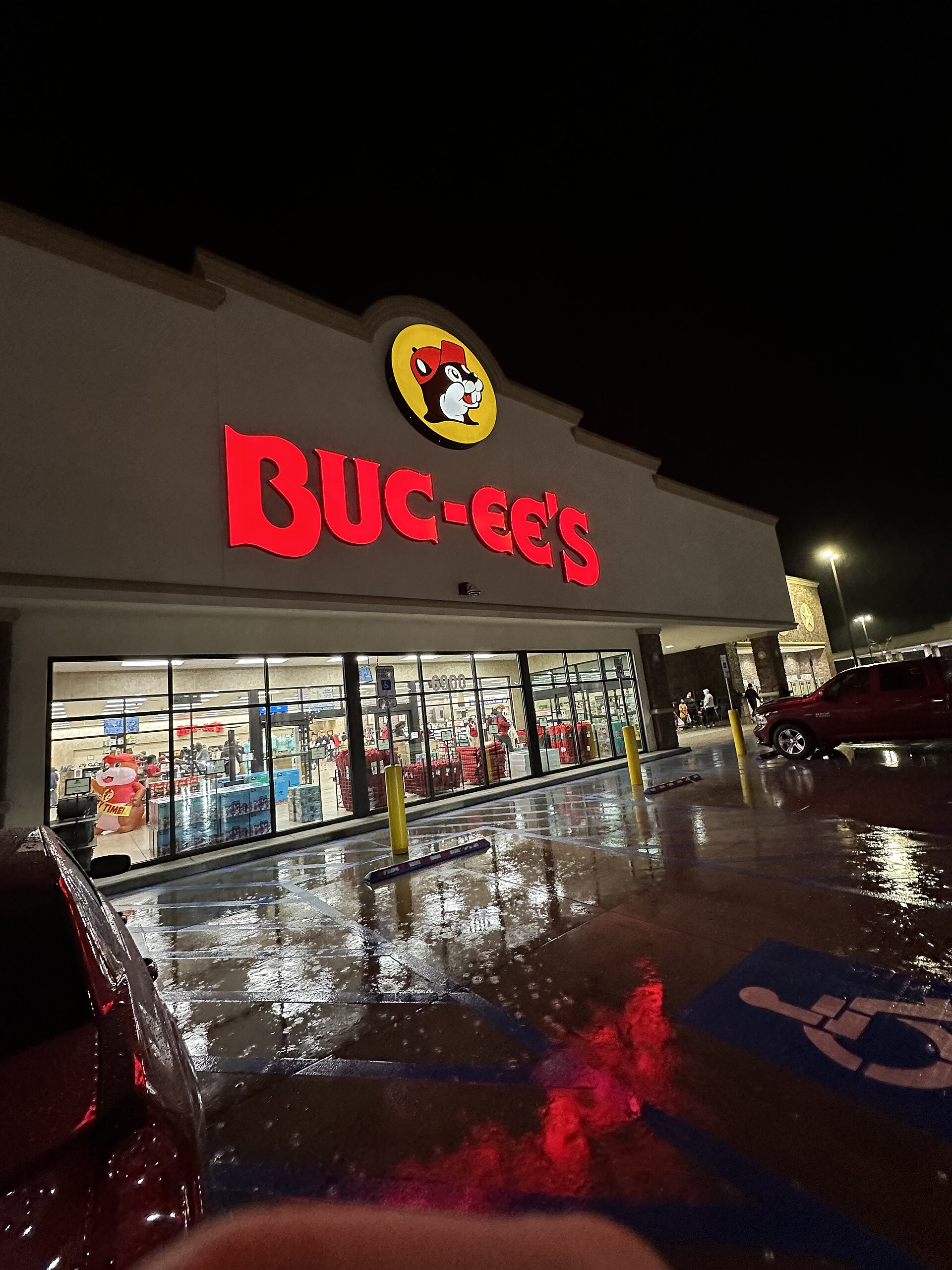
We recently took a look “under the hood” to see what type of financial impact the arrival of a Buc-ee’s can have on a community. What we found was truly “buckle up and get ready” information which we share today.
On a gray March afternoon, the wind at the I-71/Ohio 39 interchange smells mostly of diesel and wet soil. Trucks grind up the ramp, a rusted sign frame rattles in the distance, and for the most part, drivers keep moving. Exit 173 has long been a place you pass through, not a place you remember.
That’s exactly what Mansfield is trying to change. And this time, the case isn’t being made with slogans or sketches. It’s being made with numbers.
The Scale of the Proposal
The proposal reads like a balance sheet more than a vision statement. More than 70,000 square feet of retail space. Over 100 gas pumps. Around 200 full-time jobs. A footprint of more than 100 acres carved out of farmland at the southeast corner of the interchange.
It’s easy to describe Buc-ee’s as a destination or an experience. That’s the branding. But for Mansfield, the real story is simpler. It’s a revenue engine. The legal filing that arrived in early March lays out a structure that is unusually clean from a fiscal standpoint. The land is annexed, but the townships retain property-tax revenue. Richland County captures sales tax on transactions inside the store. Mansfield collects income tax on payroll and charges for water and sewer service.
That alignment matters. Too often, projects like this shift revenue from one jurisdiction to another. Here, each layer of local government gets a defined piece of the upside.
What the Numbers Actually Look Like
Strip away the excitement, and the financial impact comes into focus quickly. Using conservative assumptions based on comparable Buc-ee’s locations, annual taxable retail sales could fall somewhere between $40 million and $80 million. Payroll could reasonably land between $6 million and $10 million.
From that, the local tax picture emerges:
- Mansfield income tax (2 percent): roughly $120,000 to $200,000 per year
- Richland County sales tax (1.5 percent): roughly $600,000 to $1.2 million per year
Those aren’t speculative figures pulled from marketing material. They are grounded in standard tax rates and typical operating ranges for stores of this size.
Put more plainly, this single site could generate:
- A steady six-figure annual revenue stream for the City of Mansfield
- Close to or above $1 million per year for Richland County
And that’s before factoring in any surrounding development.
The Long View: A Decade of Revenue
Short-term gains get attention, but the real weight of a project like this shows up over time. Assuming modest growth of about 2 percent annually, the ten-year outlook becomes more substantial:
- Mansfield income tax: approximately $1.3 million to $2.1 million over ten years
- Richland County sales tax: approximately $6.6 million to $13.1 million over ten years
Those are meaningful numbers in a market like Mansfield. Not transformative on their own, but large enough to influence budgets, capital planning, and service levels. And again, that is the base case. It does not include hotels, restaurants, or additional retail that often follow high-traffic developments.
Infrastructure That Finally Has a Justification
City Engineer Bob Bianchi doesn’t talk about brisket or souvenirs. He talks about pipes and capacity. A 16-inch water main. A 10-inch sanitary sewer line. A tunnel under I-71 that has to be installed without disrupting traffic. ODOT improvements to the interchange itself.
These are not small projects, and they are not cheap. The difference now is that there is finally a user large enough to justify the investment. That’s a critical shift. Infrastructure in this area has long been discussed, rarely funded. Buc-ee’s changes that equation by anchoring demand to a specific site with predictable usage.
The Competitive Reality on the Ground
Not everyone sees this as an unqualified win.
A nearby station owner looks at the plans and sees consolidation. Buc-ee’s doesn’t cater to truckers, but it does capture families, road-trippers, and anyone looking to combine fuel, food, and rest in one stop. That matters. When consumer behavior shifts from two stops to one, smaller operators feel it immediately.
There’s no polite way to put it. A project like this creates winners and losers at the micro level, even if the macro numbers look positive.
Jobs That Actually Change the Equation
For workers, the conversation is different. Reports from other Buc-ee’s locations consistently point to wages in the high teens and twenties, along with benefits that are not typical in the local service sector. For someone earning $13 an hour across two jobs, that’s not incremental. That’s a step change.
If those wage levels hold in Mansfield, the payroll numbers used in projections may even be conservative. Higher wages mean higher taxable income, which feeds directly back into city revenue.
More importantly, it changes household stability. That doesn’t show up neatly in a spreadsheet, but it shows up everywhere else.
The Multiplier Effect Everyone Is Watching
If Mansfield follows the pattern seen in places like Springfield, Missouri or Sevierville, Tennessee, the first phase won’t be the most important one. Buc-ee’s draws traffic. Traffic draws hotels, chain restaurants, and additional retail. That second wave is where tax revenue begins to compound. The initial projections do not include that effect. They are intentionally narrow. But in practice, that is where the upside often accelerates.
The risk, of course, is overestimating how quickly that follow-on development arrives. Not every interchange becomes a corridor. Mansfield will need to actively manage zoning, access, and incentives to make sure that happens.
A Measured Opportunity
There’s a tendency to either oversell or dismiss projects like this. Neither approach is useful. This is not a complete silver bullet for Mansfield’s economy. The income-tax numbers alone make that clear. But it is also far from trivial. A reliable, recurring revenue stream paired with infrastructure investment and potential secondary development is a solid play, if managed carefully.
The real question isn’t whether Buc-ee’s will succeed. The company’s track record suggests it will. The question is whether Mansfield can turn a successful interchange into a broader economic node. That requires discipline, not just enthusiasm.
The Quiet Test Ahead
The biggest changes won’t happen on opening day. They’ll show up gradually. In quarterly income-tax reports. In county sales-tax distributions. In payroll totals. In building permits for whatever comes next.
Exit 173 has been easy to ignore for a long time. That’s about to change. What matters now is whether the dollars flowing through that interchange stay concentrated at the pumps and registers, or whether they begin to circulate more deeply through the city itself.
Image: Creative Commons License